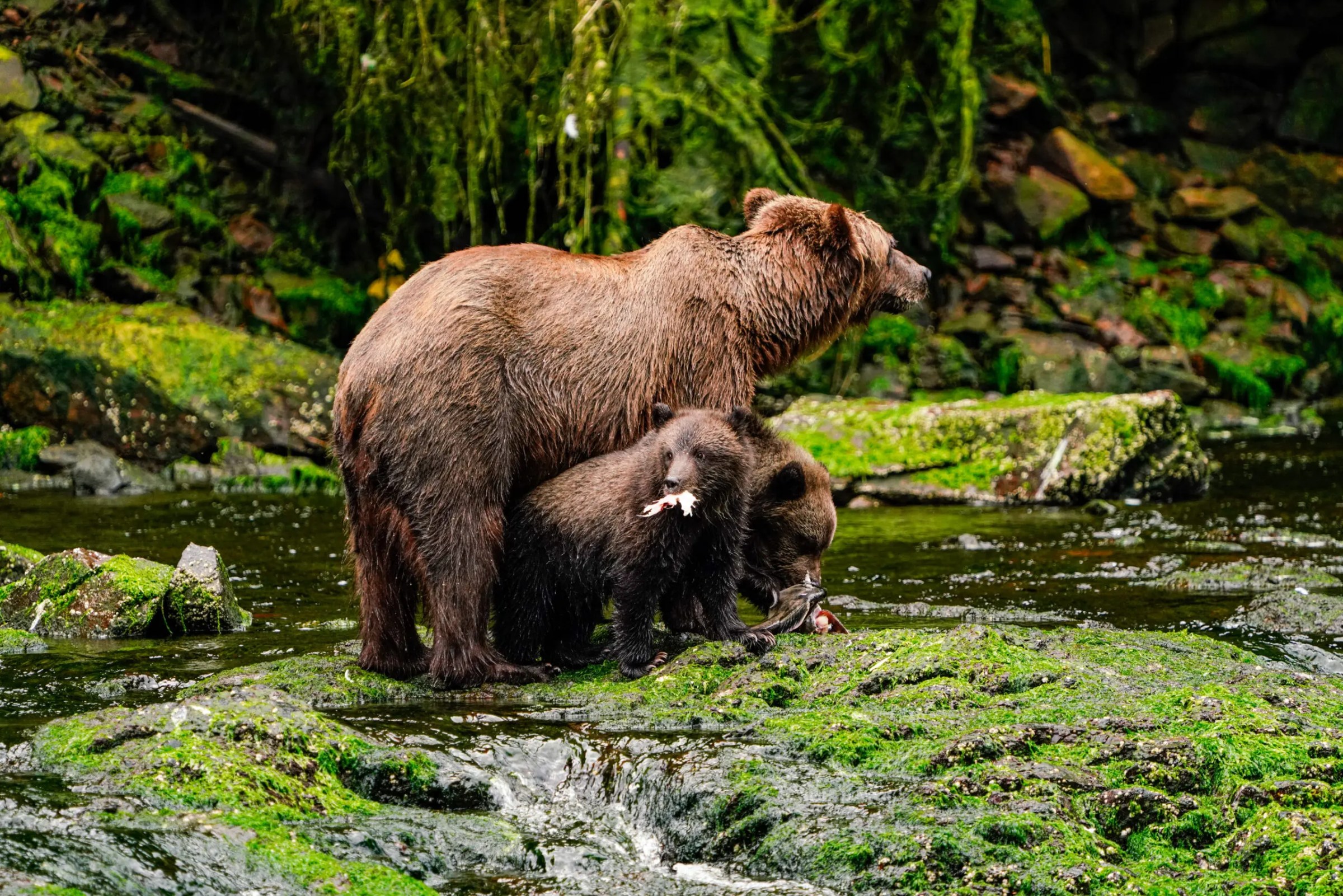
Dispatches from the Field: Pack Creek Bear Viewing in May 2026
Written by matt Brodsky, Lead Bear Viewing Guide for Wild Coast Excursions and former USFS Ranger
The bears are awake, and the 2026 bear viewing season is off to a hot start! This post talks about early-season brown bear viewing on Admiralty Island, near Juneau, Alaska.
Returning to Pack Creek: Early Season Bear Viewing Near Juneau
From my seat, 1500’ above Admiralty Island (Xutsnoowú) on May 12th, it looked like winter was holding on firmly. Snow still blanketed the land between Admiralty Cove (Tsaa T’ei Héen) and Swan Cove in upper Seymour Canal (G̲eiwk’óo). Deer trails criss-crossed through the deep, snowy muskeg, slicing the landscape into frozen tessellations. Higher above the valley floor, we flew by their switchback trails weaving their way down from the mountains. Bears, emerging from their high-elevation dens, woke to see the aftermath of one of Southeast Alaska’s snowiest winters on record. In Seymour Canal (Kanak’aa), the tide was out, and we got our first view of the large, braided estuaries and mud flats that bears frequent this time of year. I looked at the head of each creek to confirm what I’d already suspected – brown. Not the normal brown we’d expect on Admiralty – bears – but instead the brown of last summer’s vegetation. Green up was still a few days away. This time last year, winter felt like a distant memory, and the land was alive with new growth, migratory birds, and hungry bears. As the floats of our plane touched down near Windfall Island, I saw them: a familiar adult female, or sow, with two cubs following close behind, digging for clams near the tideline.
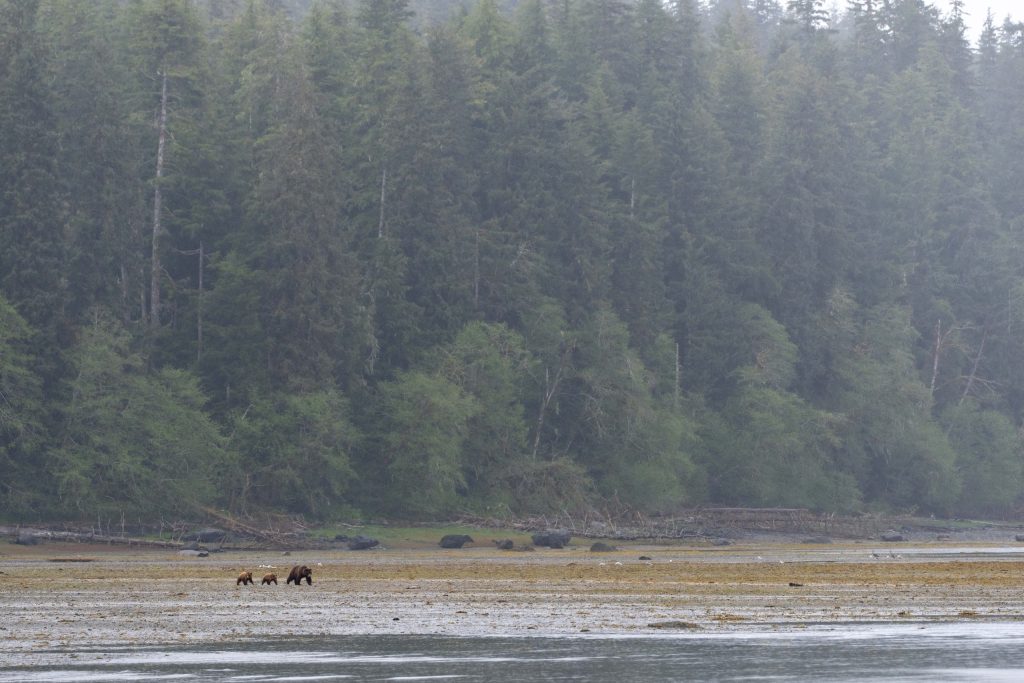
To my surprise, life abounded at Pack Creek, and most ecological cycles played out as expected. Migratory Canada Geese lined the creek, resting in the adjacent meadows. Deer, after overcoming one of the most arduous winters in recent history, relished in the snow-free meadow and tide flats and foraged on newly emerged vegetation. Bears, particularly females with cubs, roamed their familiar clamming grounds at low tide. In the meadow near the Pack Creek Viewing Spit, critical vegetation like Lyngbye’s Sedge and Cow Parsnip (yaana.eit) began to sprout, offering rich, early-season forage for bears. Spring is a lean time in a bear’s life, and every moment counts. As their metabolism ramps back up after winter’s torpor, finding food to sustain themselves is critical, especially for family groups. Despite spring’s sluggish start, the bears were on their normal routine at Pack Creek. As the land shook winter’s grasp, a growing symphony of life came into focus at Pack Creek, and the wilderness welcomed us back.
What to Expect from Early Season Bear Viewing at Pack Creek
As a guide, May is one of my favorite times to go bear-viewing. It’s a dynamic time, and the bears don’t necessarily occupy one consistent place at Pack Creek. May and early June are also fragile times – young mothers navigate life with highly dependent cubs, male bears unhabituated to human bear viewers roam large distances in search of a mate, and newly emancipated subadults learn to survive on their own. These moments require extra restraint on our part, but have incredible payoffs and give us valuable insights into the lives of individual bears. While sitting on the South Spit earlier this month, a 7.5-year-old female with two spring cubs, each only a few months old, walked by. Cubs this age are small, maybe 15-20 lbs. When they were born just months ago, they were a fraction of their current size, blind, and helpless. This was her first litter of cubs, and perhaps the first time they’d ever set eyes on humans. She paced back and forth, worried about other bears, including her 17.5-year-old mother several hundred yards away with cubs of her own. Despite her anxiety, it was clear that she was comfortable with our presence. This is the gift we receive at Pack Creek – decades of consistent, low-impact, predictable human behavior create a place where bears, even in the most fragile moments of their lives, can go about their lives without being displaced by our presence.

May is full of change and growth across the landscape in Southeast Alaska. Few changes rival the shift in a bear’s life after emancipation. Emancipation is the word scientists, rangers, and guides use to describe what happens to grown cubs: they get kicked out. After 2-4 years, an adult female enters estrous (also known as heat), which causes her body to release pheromones signalling her body’s reproductive status. Male bears, full of hormones, follow the scent and find receptive females to court. When these females also have a litter of cubs, their instinct tells them to push them off, often aggressively. At this point in their life, cubs only know life with their mother. They are reliant on her, and mirror her actions for years. Newly emancipated cubs don’t willingly leave their mothers, and some will linger near her for days, weeks, or perhaps years. This is the case with a 4.5-year-old male at Pack Creek, who was emancipated in the spring of 2024. His mother, the same 17.5-year-old female mentioned before, has a new litter of cubs. Even though he’s spent almost two years on his own at this point, this subadult male still entered his mother’s orbit at times. As a group and I watched her and her new cubs grazing, this playful young male wandered closely by, keeping his distance but gravitating toward her and his half-siblings. For over an hour, he grazed nearby, eating young yaana.eit, and leaving his scent on logs we’d sit on in just a few months.
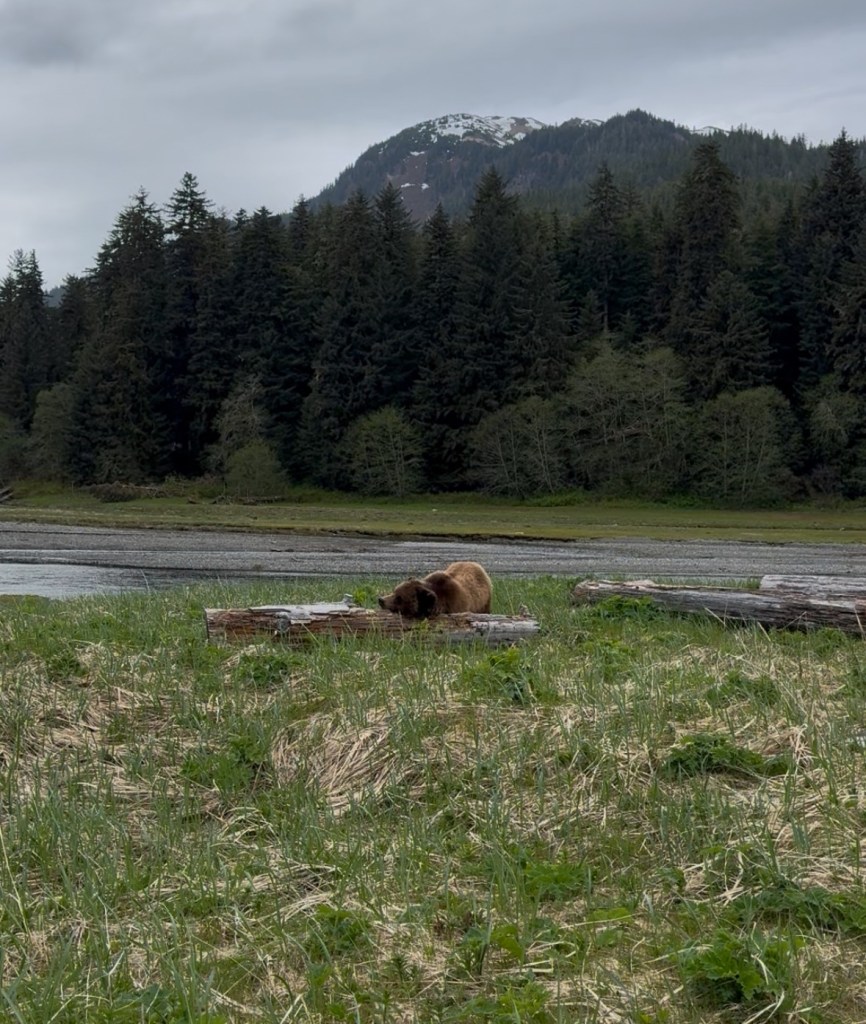

Above: A 4.5-year-old subadult male leaves his scent on the sitting logs at Pack Creek’s Viewing Spit
(photos by Matt Brodsky)
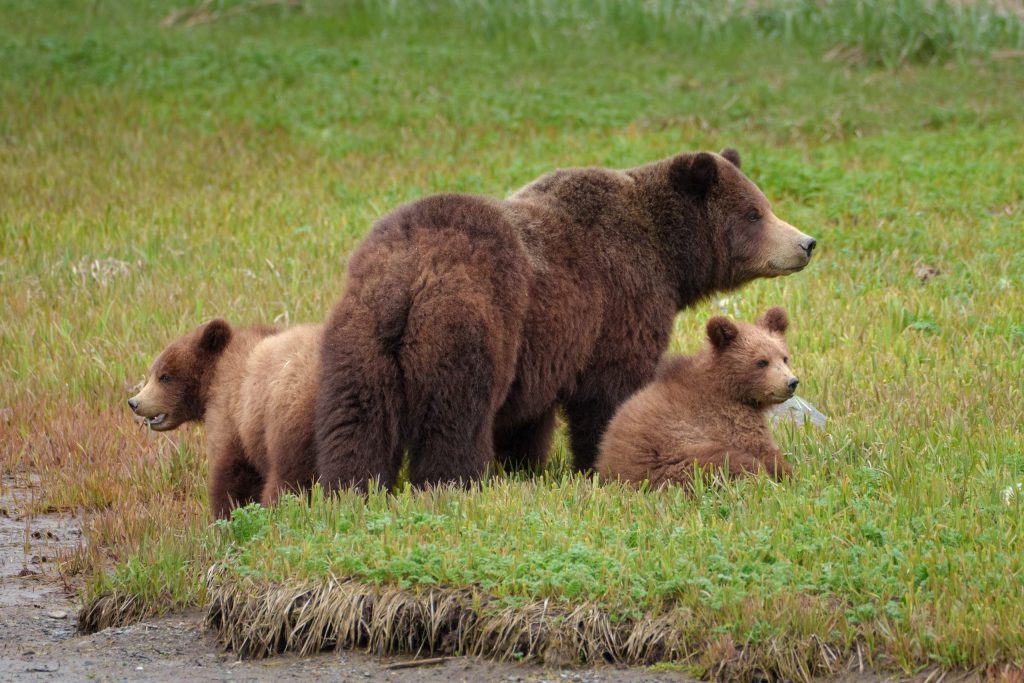
Below: The 17.5-year-old female with her cubs (photo by Nathan Kelley)
Brown Bear Mating Season on Admiralty Island
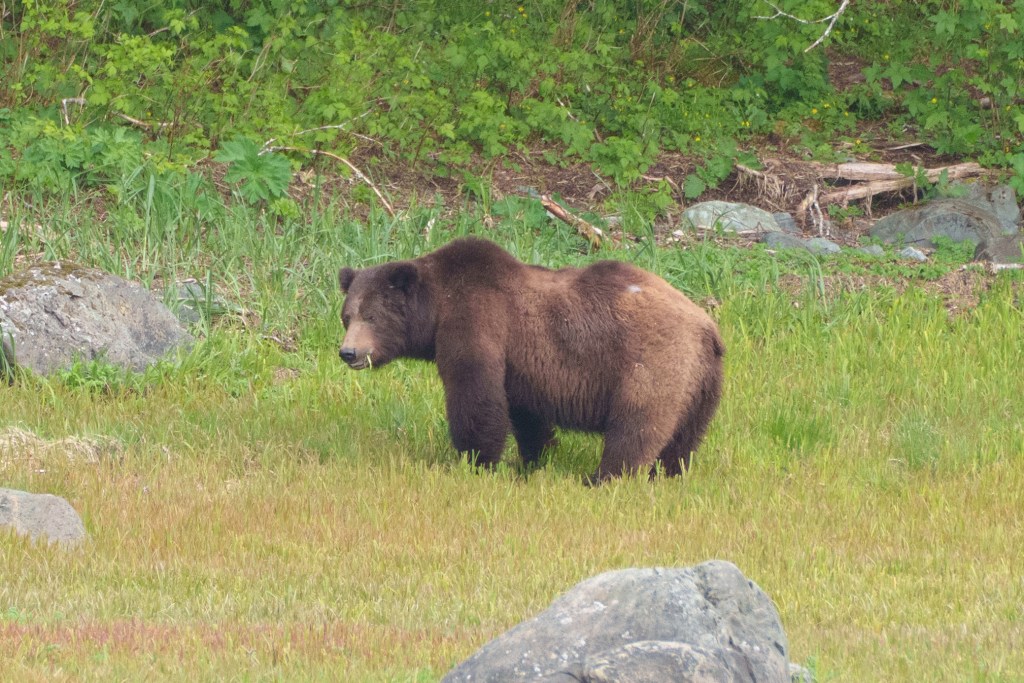
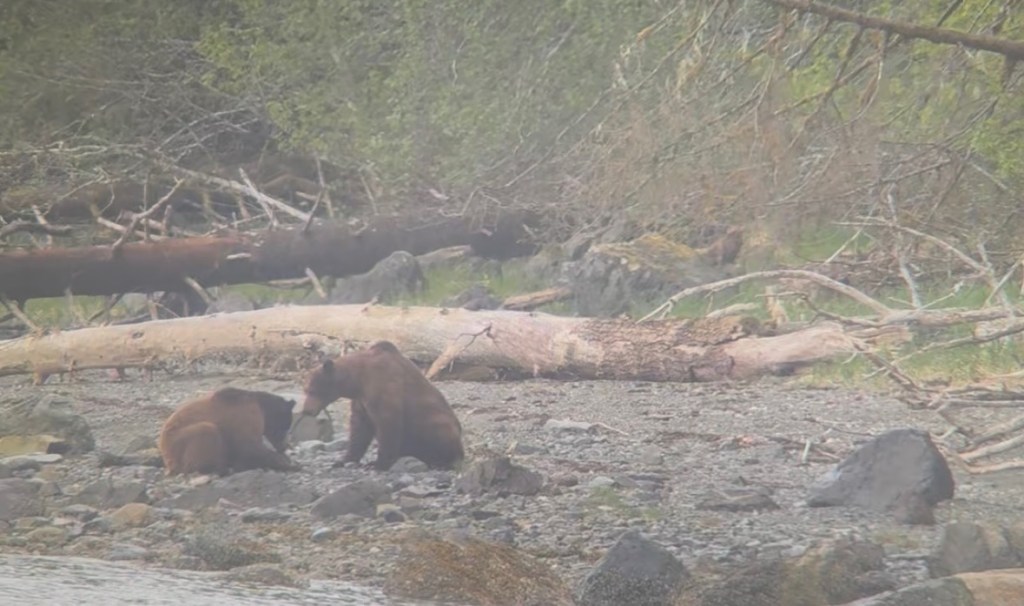
For the majority of the year, most bears seen at Pack Creek are family groups, subadults who grew up there, or solo females. Adult males are seen at times, but their level of habituation and trust in people is often significantly lower than the typical Pack Creek bear. May is one of the exceptions to that pattern. For a short period of time, unhabituated males frequent Pack Creek, lured in by their drive to mate. In the last few weeks, we’ve seen several large adult males, often at further distances. Until the last week of May, these males were solitary, foraging for sedge or winter-killed deer. On the 27th, something special happened: a courting pair was seen for the first time. Brown bears court for a few weeks at most, and the window that females are in heat is short. One member of the courting pair was a familiar Pack Creek bear: a 31.5-year-old female, and one of the oldest known mating females in the world. As the female approached Pack Creek from the south, the male anxiously guarded her, blocking her from exiting the beach. At times, she would lie down, calmly facing him, almost submissively. Calm moments are rare during courting, and are often interrupted by unwelcome advances from the male. Those brief moments of ease tell a story, though: the two bears will likely mate, and soon. When a female begins to ovulate due to the male’s persistence, she’ll show fewer signs of stress and become more tolerant of the male’s presence. Outside of breeding season, a large male is a threat to a solo female, so it takes time for the female to become receptive.
Why May Is One of the Best Times for Bear Viewing at Pack Creek
Many of the most unique bear viewing opportunities happen at Pack Creek during early-season, particularly in May. Some behaviors, like courting, only happen in a short window throughout May and early June. These early-season experiences, like seeing a new litter of cubs with a first-time mother, or a subadult who just survived their first winter alone, give us poignant glimpses into a bear’s life. These special moments have the power to reshape our relationship with bears and to appreciate the wild spaces that hold them. These moments remind us that every bear at Pack Creek has a story, and that spring is one of the best times to watch those stories unfold.
Planning a Bear Viewing Trip Near Juneau?
Interested in learning more about bear viewing on Admiralty Island and throughout Southeast Alaska? These resources can help you plan your trip and better understand the bears and places featured in this article.
Explore More
- Pack Creek Bear Viewing Tour – Learn more about visiting Pack Creek with an experienced local guide.
- What To Expect at Pack Creek (2026)
- Where to See Bears in Juneau (2026 Local Guide Update)
- Juneau’s Best Bear Viewing: Inside Two Premier Wilderness Destinations
- When to See Bears in Juneau: A Month-by-Month Guide to Pack Creek & Waterfall Creek (2026)
- Pack Creek Bear Viewing: A Complete Guide for 2026
Whether you’re interested in seeing spring cubs at Pack Creek, salmon-fed bears at Waterfall Creek, or simply learning more about Southeast Alaska’s coastal brown bears, we hope to see you in bear country.
Works Cited:
Eggleston, Keri (2019). Haa Shuká Yóo X̲’atángi (Dictionary of Tlingit)